
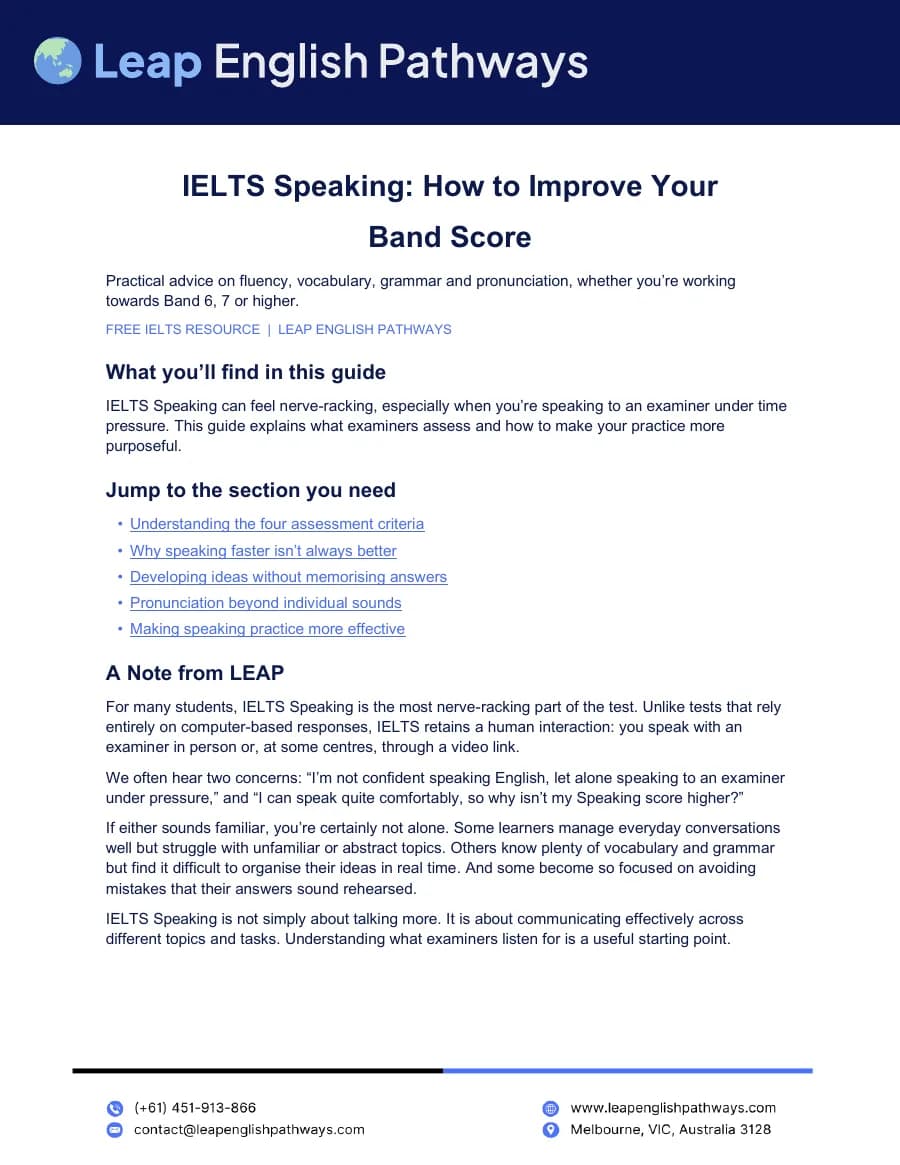
How to improve your IELTS Speaking band
What the examiner listens for in each of the four criteria, with short and developed answers side by side.

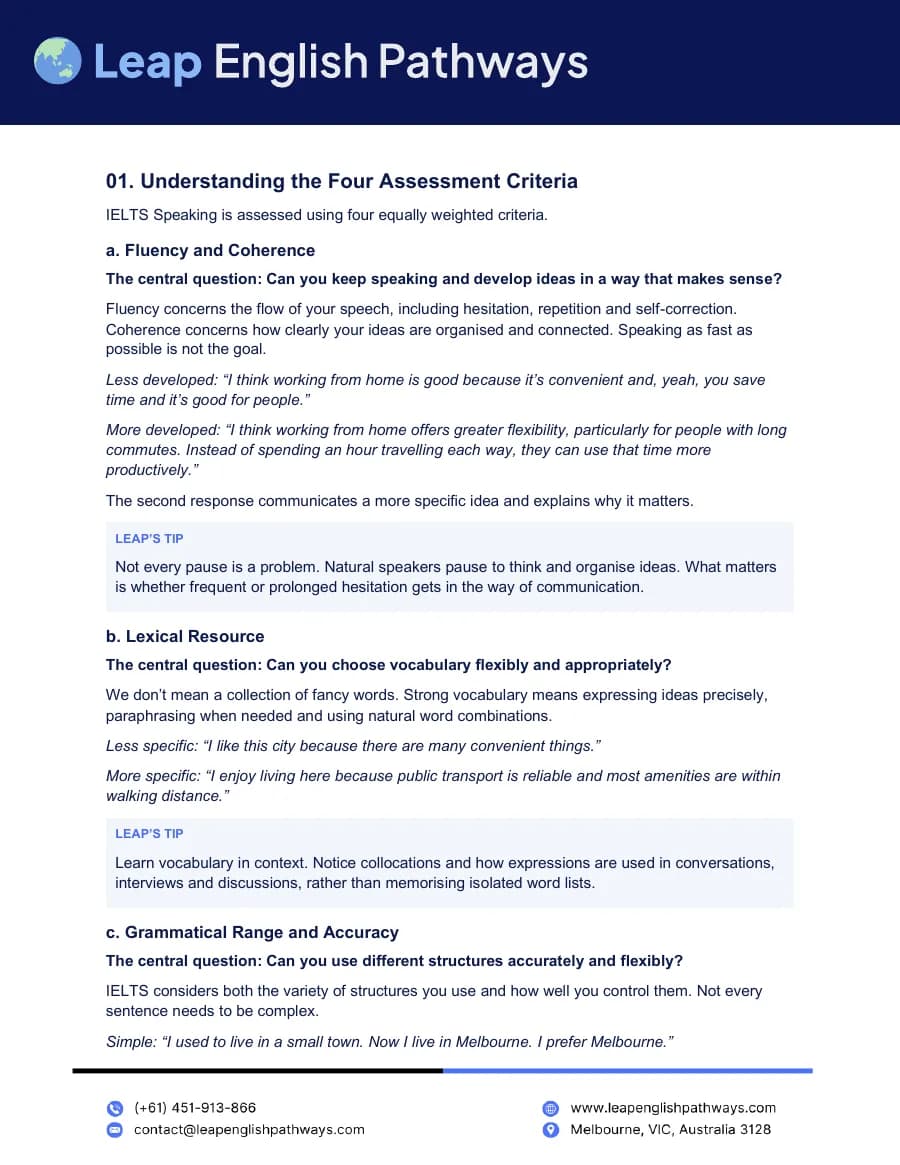
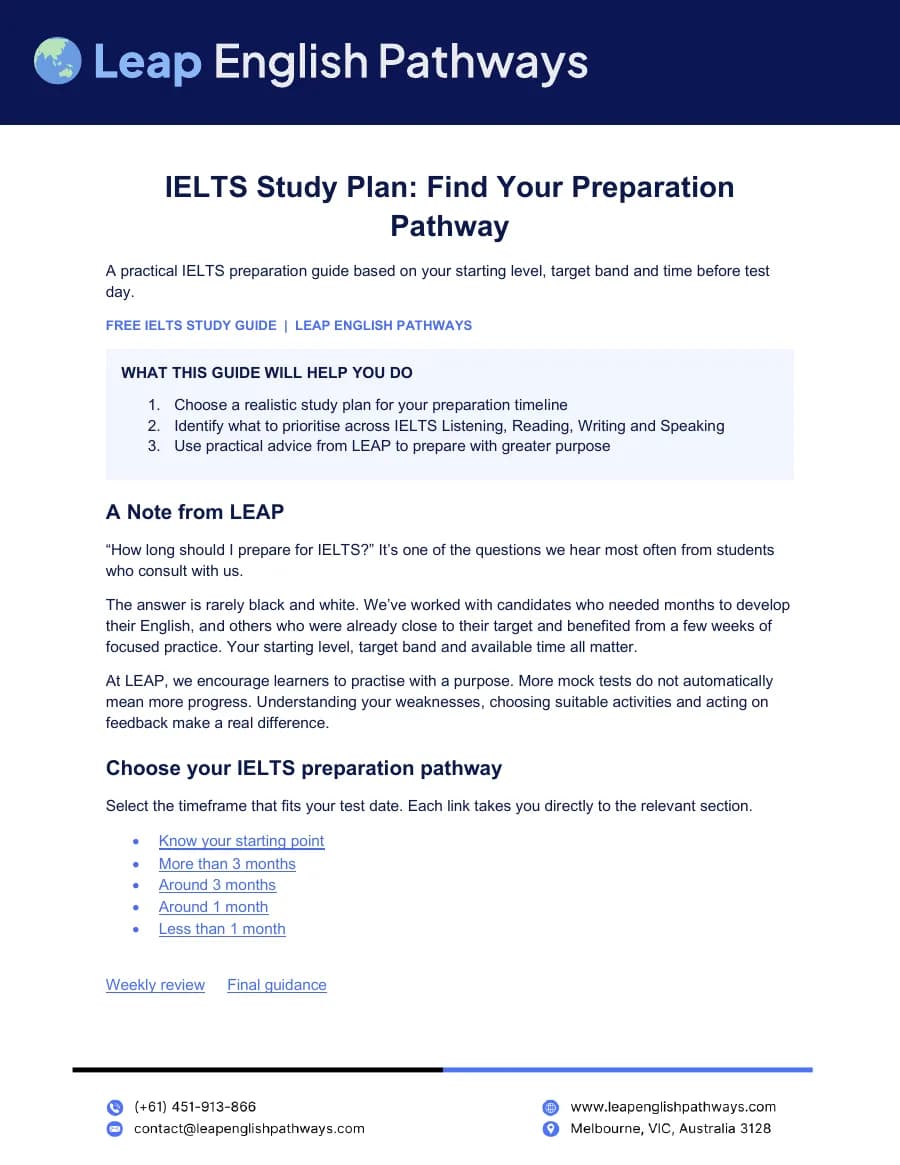
What's in the guide
6 pages in 5 parts. Find the part you need, then turn to its page.
- Page 2
The four criteria
Fluency and coherence, vocabulary, grammar and pronunciation, and the question each one asks.
- Page 3
Speaking faster
Why speed isn't fluency, and when words like “um” become a problem.
- Page 4
Developing your ideas
How to go past one or two sentences in Part 3 without a learned answer.
- Page 4
Pronunciation
Word stress, sentence stress, tone and linked words. You don't need a new accent.
- Page 5
Better practice
Five steps: pick a new topic, record, listen, choose one thing to fix, try again.
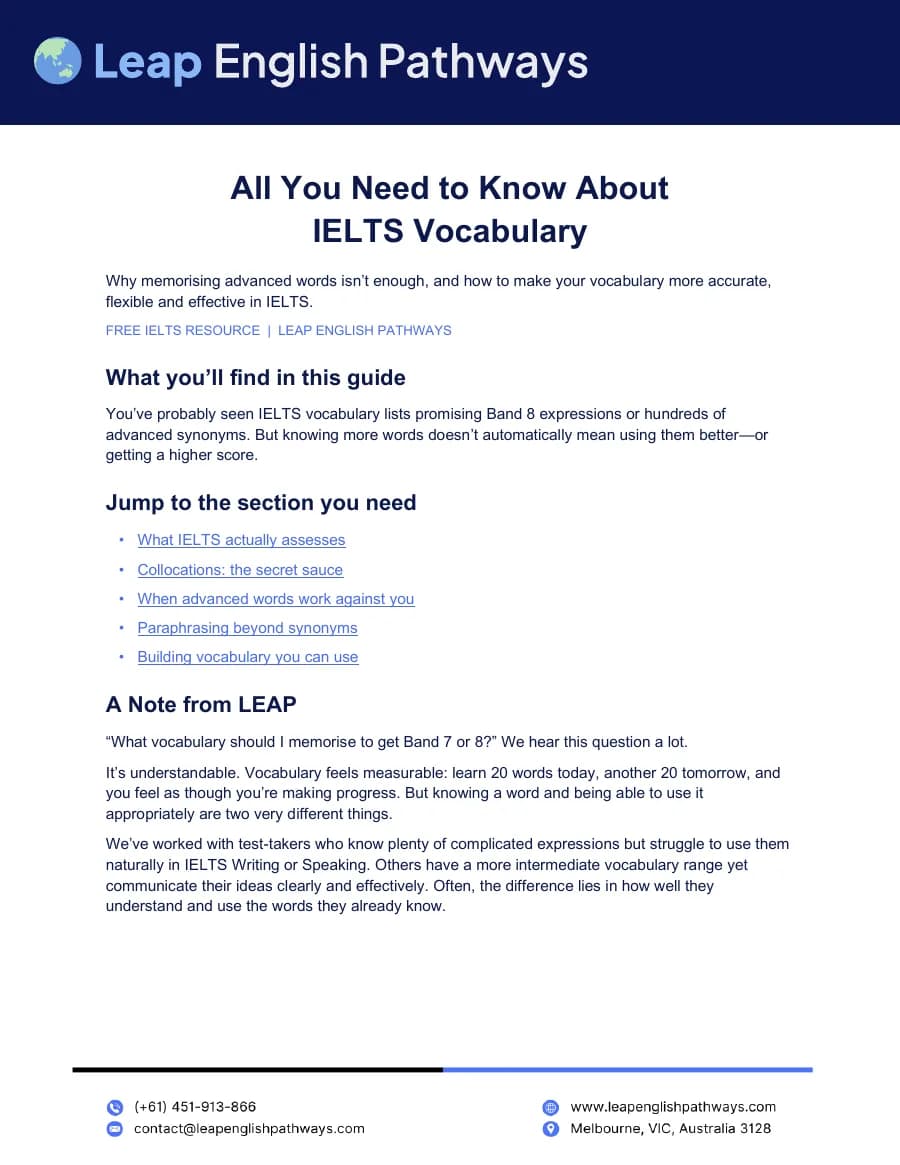
Tips from the guide
- Not every pause is a problem. It matters when long or frequent pauses get in the way of your message.
- Learn words with the words around them. Notice how people use a phrase in talks and interviews, not in a word list.
- Record a one-minute answer to a new question. Then check: was your main point clear, and did you explain it?
The four things the examiner marks
IELTS Speaking is marked on four criteria, and each one counts the same.
From page 2 of the guide.
Fluency and coherence
Can you keep talking and link your ideas so they make sense? Speed isn't the goal.
- Less developed
- “I think working from home is good because it's convenient and, yeah, you save time and it's good for people.”
- More developed
- “I think working from home offers greater flexibility, particularly for people with long commutes. Instead of spending an hour travelling each way, they can use that time more productively.”
Lexical resource
Can you choose the right words for your idea? It isn't about fancy words. It's about saying things clearly, with words that go together.
- Less specific
- “I like this city because there are many convenient things.”
- More specific
- “I enjoy living here because public transport is reliable and most amenities are within walking distance.”
Grammatical range and accuracy
Can you use different structures and get them right? Not every sentence needs to be complex.
- Simple
- “I used to live in a small town. Now I live in Melbourne. I prefer Melbourne.”
- More flexible
- “Although I grew up in a small town, I've come to prefer living in Melbourne because there are more opportunities to meet people from different backgrounds.”
Pronunciation
How easily can people understand you? You don't need a British, American or Australian accent. Stress on the key words and the right tone make a big difference.
Practise IELTS SpeakingIELTS Speaking testIELTS Speaking band descriptors
常见问题
What does the IELTS Speaking examiner mark?
Should I speak fast to show fluency?
Do I need a British or Australian accent?
Is the PDF free?
获取 IELTS Speaking guide