
PTE Summarize Written Text template
One sentence in four parts for each of the 7 kinds of passage, with the joining words that link them.

Par Thanh Tran, cofondation et enseignement du PTE
Mis à jour en
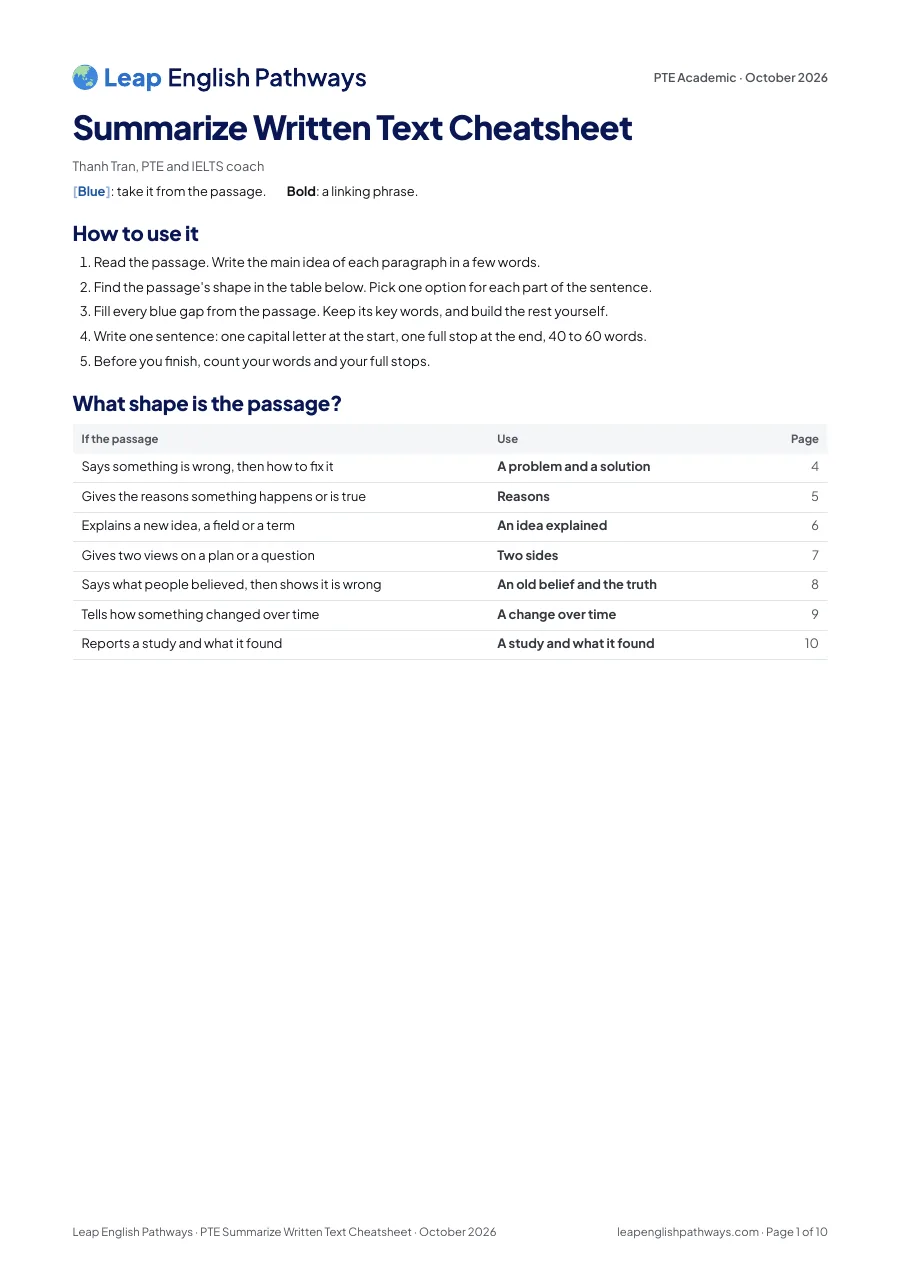
What shape is the passage?
Pick the kind of passage you read. Its template opens.
Blue: take it from the passage.Bold: a linking phrase.
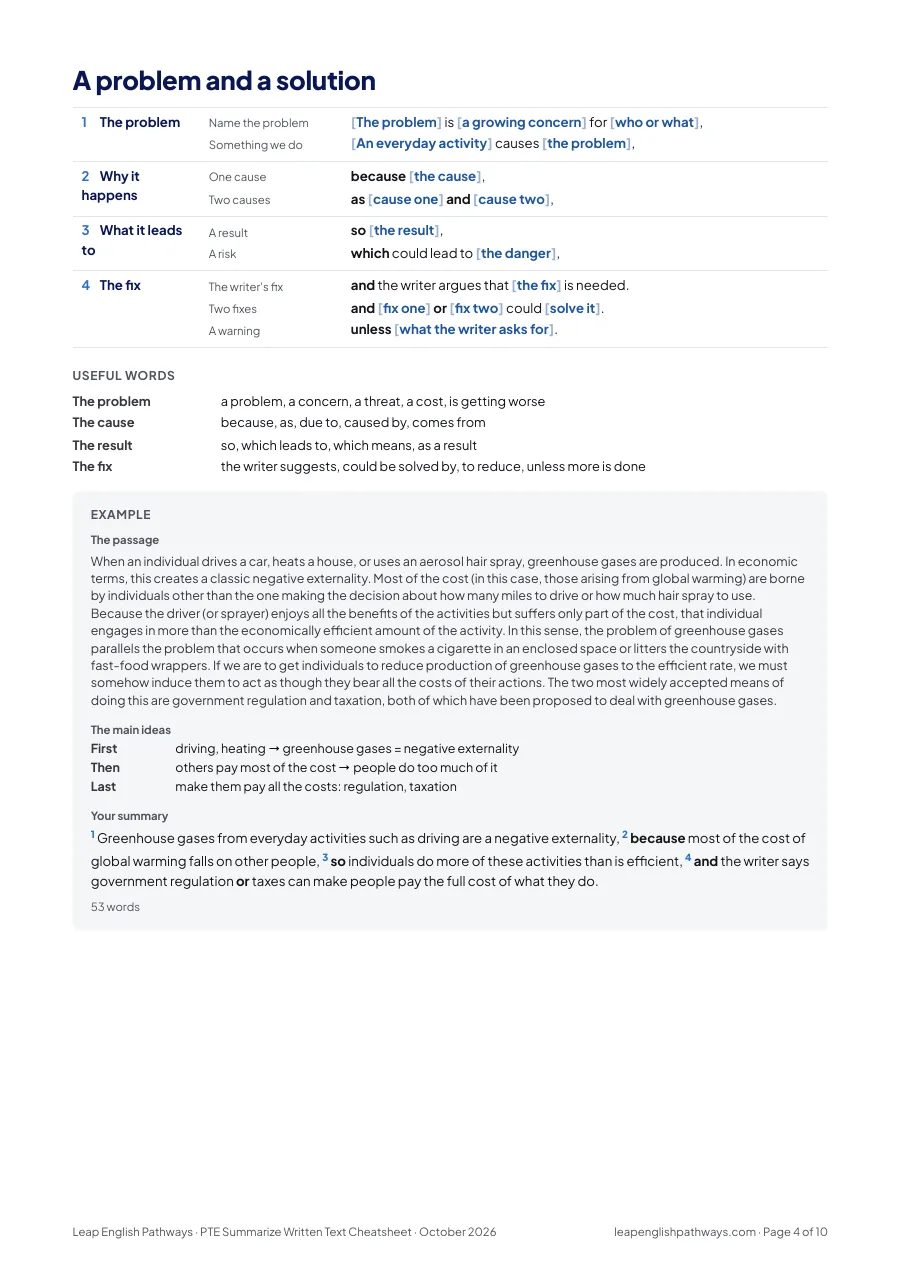
- The problem
- Name the problemThe problem is a growing concern for who or what,
- Something we doAn everyday activity causes the problem,
- Why it happens
- One causebecause the cause,
- Two causesas cause one and cause two,
- What it leads to
- A resultso the result,
- A riskwhich could lead to the danger,
- The fix
- The writer's fixand the writer argues that the fix is needed.
- Two fixesand fix one or fix two could solve it.
- A warningunless what the writer asks for.
- What is true
- Something is trueThe topic is the claim
- Something grewThe topic has grown or changed over the period
- The first reason
- The main reasonbecause reason one,
- A causedue to cause one,
- The next reason
- Another reasonbecause reason two,
- It leads onwhich spreads or grows through reason two,
- The last reason
- The last reasonand because reason three.
- What it meansso what all this means.
- What it is
- A new idea or fieldThe idea is a new field that does what,
- A word or termThe term means what it means,
- How it works
- The idea behind itbased on the idea that the core idea,
- How it workswhich works by how it works,
- An example
- What we can doso we are learning to do what,
- Examplessuch as example one and example two,
- Why it matters
- Why it mattersand the writer sees it as why it matters.
- What it could bringwhich could lead to the benefit.
- The question
- A planA plan to do something has divided opinion,
- A questionThe question is debated,
- One side
- One sidewith supporters arguing that their view,
- Two good pointsas the first advantage and the second,
- The other side
- The other sidewhile critics say that their view,
- The drawbacksbut it could the main drawback,
- Where it stands
- Still openso the debate over the question continues.
- The writer decidesbut the writer believes the writer's view.
- The old view
- A common beliefAlthough people have long believed that the old view,
- An accepted ideaWhile the accepted idea has long been accepted,
- The truth
- New researcha study of what found that the truth,
- An expertthe expert now argues that the truth,
- Why it was missed
- Why it was missedand it was overlooked because the reason,
- The evidenceas the evidence,
- What else was found
- Morewhile a further finding.
- What it meanswhich means what it means.
- What changed
- A big changeThe topic has changed greatly over the period,
- A storyWho did what in year,
- How it was
- How it wasfrom how it used to be
- The startstarting with the first step,
- How it is now
- How it is nowto how it is now,
- What came nextand then the next step,
- The twist
- A surprisealthough what has not changed.
- The resultwhich led to the result.
- The finding
- A clear findingWho did what were less likely to the result,
- A suggestionDoing what may help with what,
- The study
- The studyaccording to a study of how many people over how long,
- Who did itaccording to researchers at where who tracked whom,
- Compared with
- It matters morewhich found it mattered more than other causes,
- For whomespecially for which group,
- Why it may work
- Whyand experts believe the reason.
- A limitalthough what the study can't show.
Essayez maintenant sur une vraie question
Répondez à une question Summarize Written Text dans notre application d'entraînement. Notre système de correction la note en quelques secondes : vous savez quoi corriger ensuite.
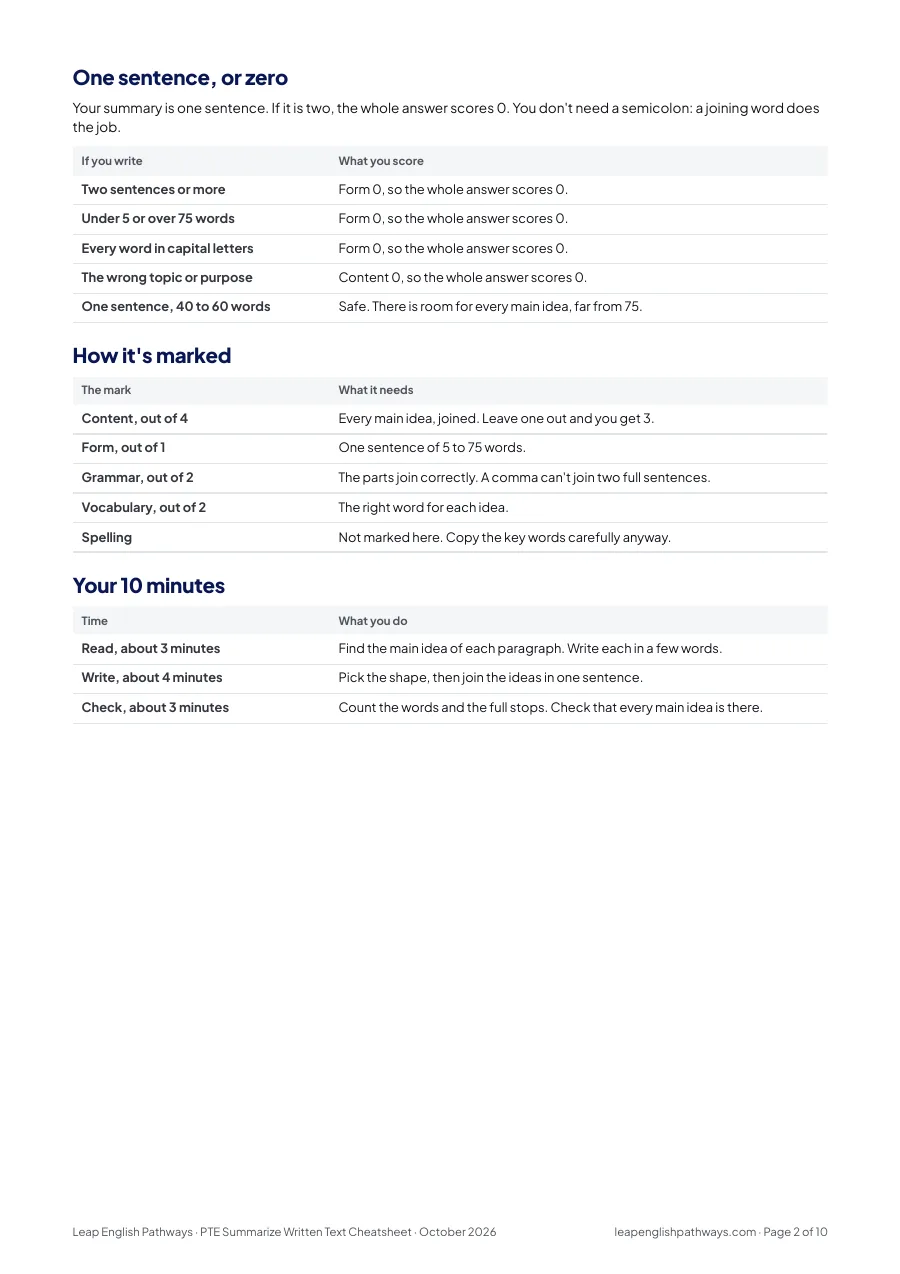
How to use it
Read the passage. Write the main idea of each paragraph in a few words.
Find the passage's shape in the table below. Pick one option for each part of the sentence.
Fill every blue gap from the passage. Keep its key words, and build the rest yourself.
Write one sentence: one capital letter at the start, one full stop at the end, 40 to 60 words.
Before you finish, count your words and your full stops.
An example answer
The a problem and a solution template, used on a real question. The PDF has an example answer for all 7 templates.
1Greenhouse gases from everyday activities such as driving are a negative externality, 2because most of the cost of global warming falls on other people, 3so individuals do more of these activities than is efficient, 4and the writer says government regulation or taxes can make people pay the full cost of what they do.
PTE Summarize Written Text : durée et notationLes templates sont-ils autorisés au PTE ?
Questions fréquentes
Are templates allowed in PTE Summarize Written Text?
How many words in Summarize Written Text?
Do I need a semicolon to make one sentence?
How should I use the 10 minutes?
Is the PDF free?
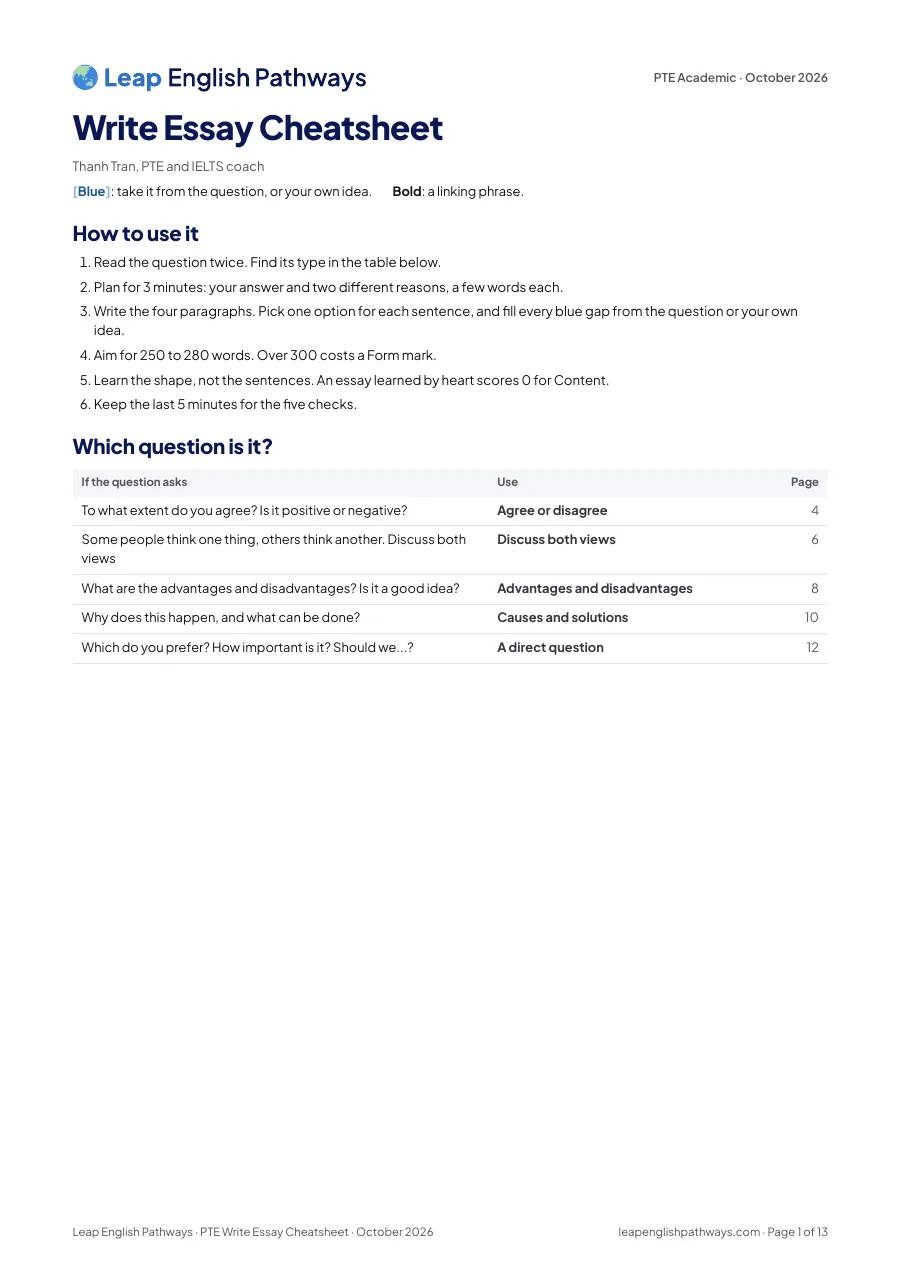
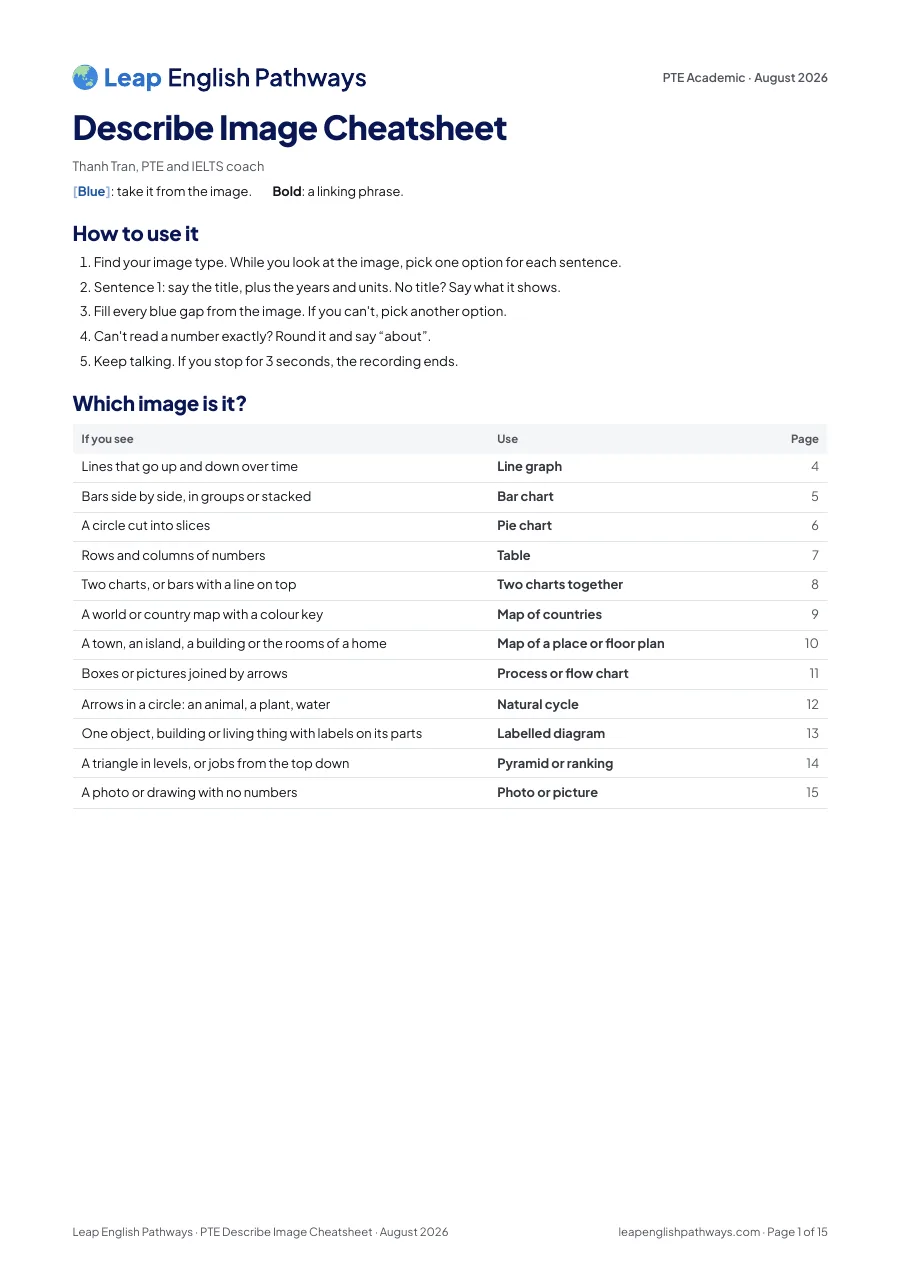
Recevez votre PDF : Summarize Written Text template