
PTE Summarize Spoken Text template
Five sentences for each of the 7 kinds of lecture, with the reporting verbs and the word limits that matter.

글: Thanh Tran, 공동 설립자 겸 PTE 강사
업데이트
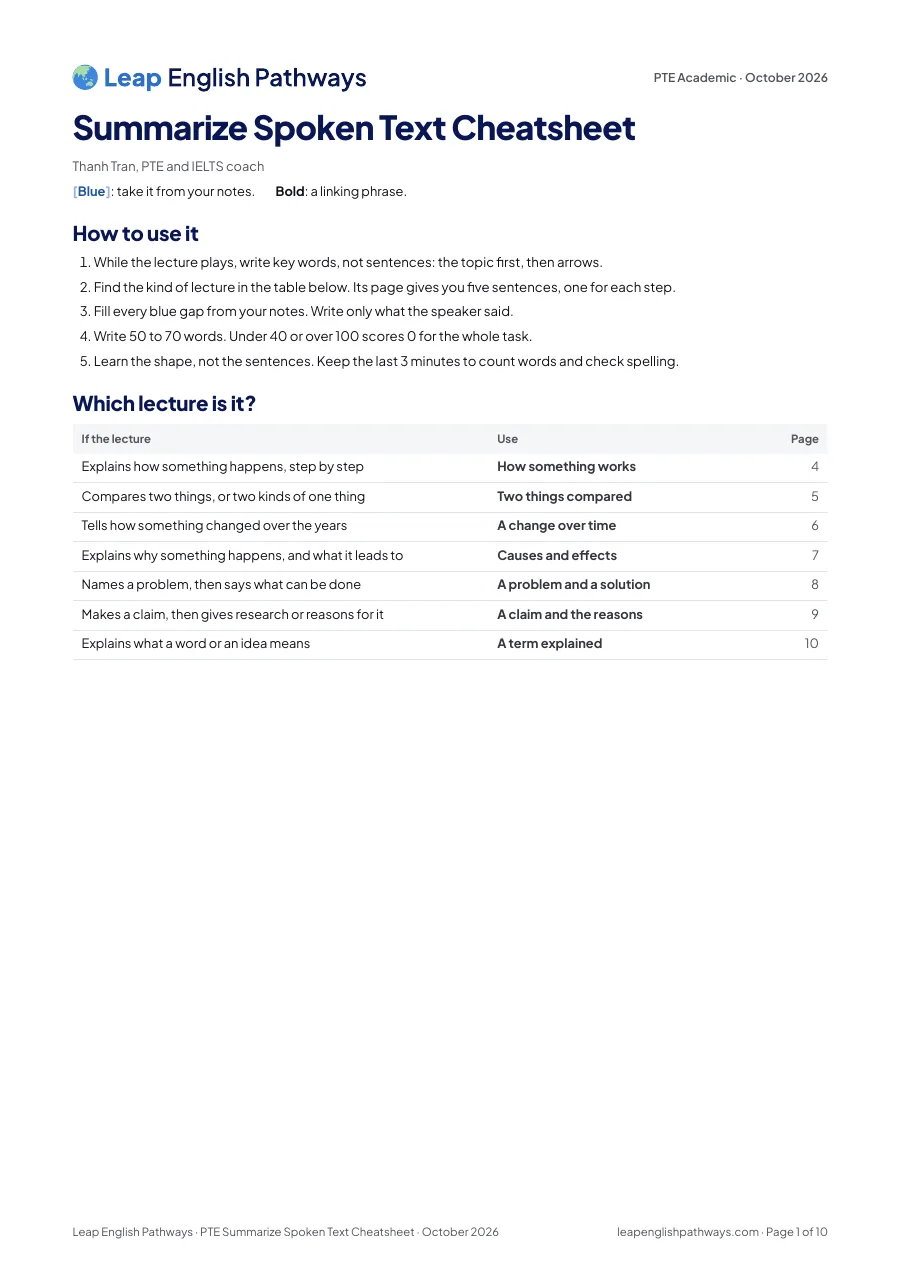
Which lecture is it?
Pick the kind of lecture you hear. Its template opens.
Blue: take it from your notes.Bold: a linking phrase.
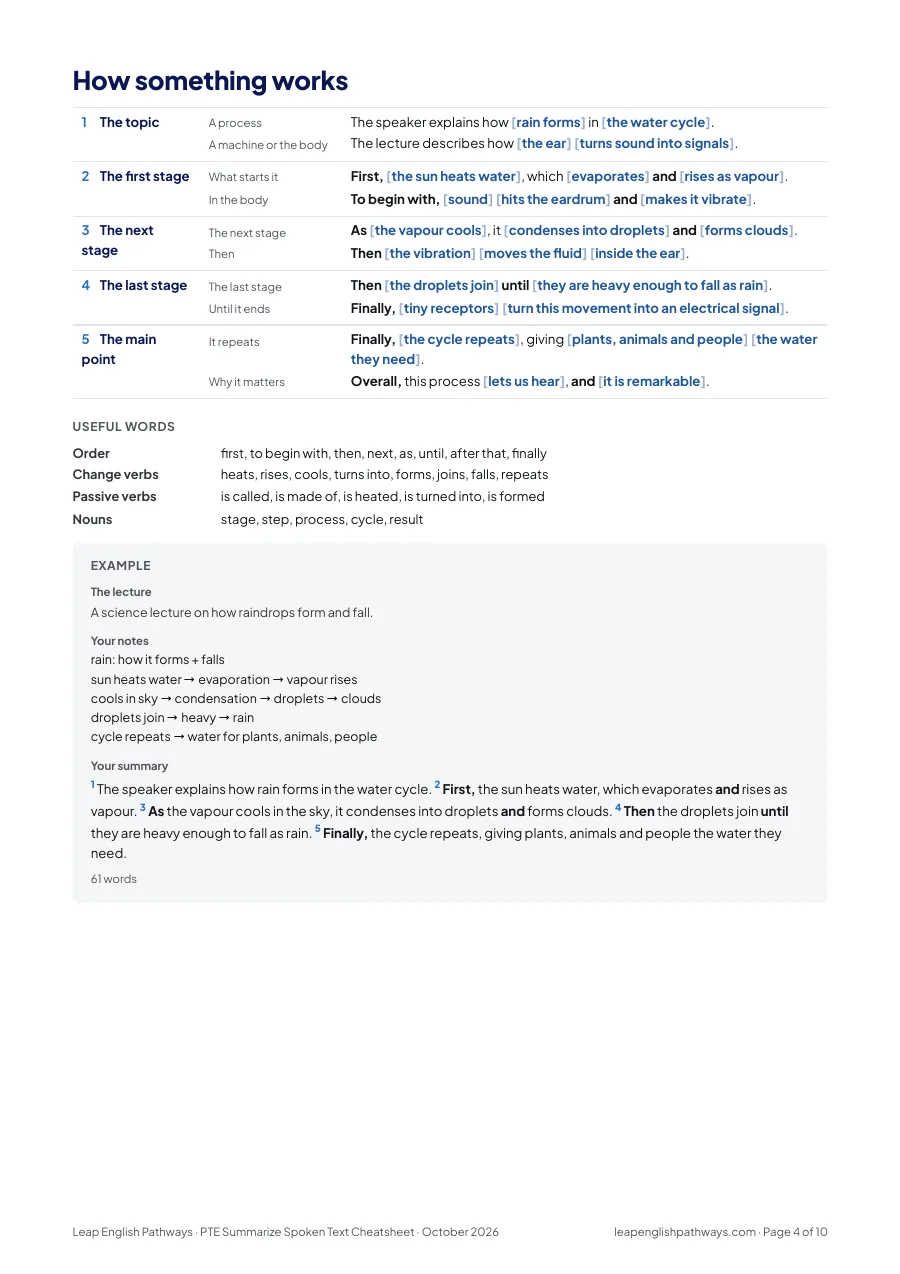
- The topic
- A processThe speaker explains how rain forms in the water cycle.
- A machine or the bodyThe lecture describes how the ear turns sound into signals.
- The first stage
- What starts itFirst, the sun heats water, which evaporates and rises as vapour.
- In the bodyTo begin with, sound hits the eardrum and makes it vibrate.
- The next stage
- The next stageAs the vapour cools, it condenses into droplets and forms clouds.
- ThenThen the vibration moves the fluid inside the ear.
- The last stage
- The last stageThen the droplets join until they are heavy enough to fall as rain.
- Until it endsFinally, tiny receptors turn this movement into an electrical signal.
- The main point
- It repeatsFinally, the cycle repeats, giving plants, animals and people the water they need.
- Why it mattersOverall, this process lets us hear, and it is remarkable.
- The topic
- Two thingsThe speaker explains the difference between fiction and nonfiction.
- Two kindsThe lecture describes two ways that rain forms.
- The first one
- The first oneFiction tells imagined stories, such as novels and films.
- With a numberThe first kind makes up about 40 percent of rain and comes from fronts.
- The second one
- The second oneIn contrast, nonfiction deals with facts, such as biographies.
- Most of itHowever, most rain comes from convection, when warm ground heats the air.
- The turn
- A surpriseHowever, these facts can later be proven false.
- Easy or hardThe first kind is easy to track, but the second is much harder to predict.
- The main point
- The key differenceOverall, fiction is mostly made up, while nonfiction aims to tell the truth.
- Why it mattersSo forecasters can predict one kind well, but not the other.
- The topic
- Then and nowThe speaker describes how air pollution has changed since the 1950s.
- A historyThe lecture tells the history of chocolate, from the Aztecs to today.
- Then
- How it wasIn the 1950s, thick smogs from factories were common and caused health problems.
- How it startedAt first, cocoa was used as a drink.
- What changed it
- A turning pointAfter a smog killed thousands in London, a new law ended the smogs.
- Then it grewLater, it spread to Europe, where it became popular.
- Now
- NowToday, pollution is invisible and comes mainly from cars and lorries.
- By the endBy the 1800s, it had become a food for everyone.
- The main point
- Why it is still a problemBecause we depend more on vehicles, it is still a risk to health.
- What it showsOverall, the topic has changed from what to what.
- The topic
- Why it happensThe speaker explains how the African grass mouse is protected from the sun.
- What it leads toThe lecture looks at why some boys leave school early.
- The cause
- One causeBecause it is active by day, it spends hours in strong sun.
- Two causesThis is caused by push and pull factors, such as jobs.
- The first effect
- An effectAs a result, it has a lot of melanin, a dark pigment, in its skin.
- For one groupFor boys, leaving early is not always bad, because there are jobs.
- The second effect
- Another effectIn addition, it has an unusual layer of pigment between its skull and skin.
- For another groupIn contrast, girls find fewer jobs, so leaving early harms them more.
- The main point
- What it showsOverall, the mouse shows that animals, like humans, can evolve to cope with strong sun.
- Who it affectsSo the same cause affects boys and girls very differently.
- The topic
- A problemThe speaker describes the problem of food waste in the United States.
- AdviceThe speaker gives advice on how to solve a complex problem.
- How big it is
- With numbersHouseholds waste about 43 percent of their food, costing a family of four about 1,500 dollars a year.
- Who it hurtsThe problem affects young researchers, because fewer papers are published.
- Why it happens
- The causesMost waste comes from supermarkets and from how people shop and eat.
- One causeIt happens because people try to solve everything at once.
- What can be done
- The fixTo solve this, waste should be cut along the supply chain and at home.
- StepsFirst, break the problem into smaller parts, then solve them one at a time.
- The main point
- What it would bringHalving food waste could feed a growing population and reduce harm to the environment.
- The keyOverall, small steps are the key to solving big problems.
- The topic
- ResearchThe speaker explains why silent meetings can work better.
- A viewThe speaker argues that sharing apps are helping people trust each other again.
- The claim
- The claimResearch shows they produce better ideas when the goal is to solve problems.
- Against the trendAlthough trust in society has fallen, people trust strangers online.
- The first reason
- A reasonThis is because writing in silence makes people less afraid of sharing new ideas.
- EvidenceFor example, people choose what to buy from online reviews.
- Another reason
- Another reasonAlso, everyone can share ideas at once, instead of waiting their turn.
- How to do itTo do this, people write ideas alone, then group them and vote.
- The main point
- The main pointOverall, meetings have different goals, so they need not all look the same.
- What may followAs a result, the economy could grow, as it has each time trust grew.
- The topic
- A termThe speaker explains what a patent is and how it works.
- An ideaThe lecture explains the idea of globalization and its meanings.
- What it means
- What it meansA patent is a legal right that protects an invention for twenty years.
- Two meaningsIt can mean one thing or another, depending on who uses it.
- How it is used
- How it is usedInventors apply for one so that others cannot copy their work.
- An exampleFor example, what the speaker gives as an example.
- Another side
- Another sideHowever, it can also slow progress, because others cannot build on the idea at once.
- A limitBut it does not last forever, so others can use the idea later.
- The main point
- Its purposeOverall, the system aims to protect inventors while helping new ideas grow.
- Why it mattersSo the idea matters because what it changes.
이제 실제 문제로 해 보세요
저희 연습 앱에서 Summarize Spoken Text 문제 하나에 답해 보세요. 저희 엔진이 몇 초 만에 채점해서, 다음에 무엇을 고칠지 알려 드려요.
How to use it
While the lecture plays, write key words, not sentences: the topic first, then arrows.
Find the kind of lecture in the table below. Its page gives you five sentences, one for each step.
Fill every blue gap from your notes. Write only what the speaker said.
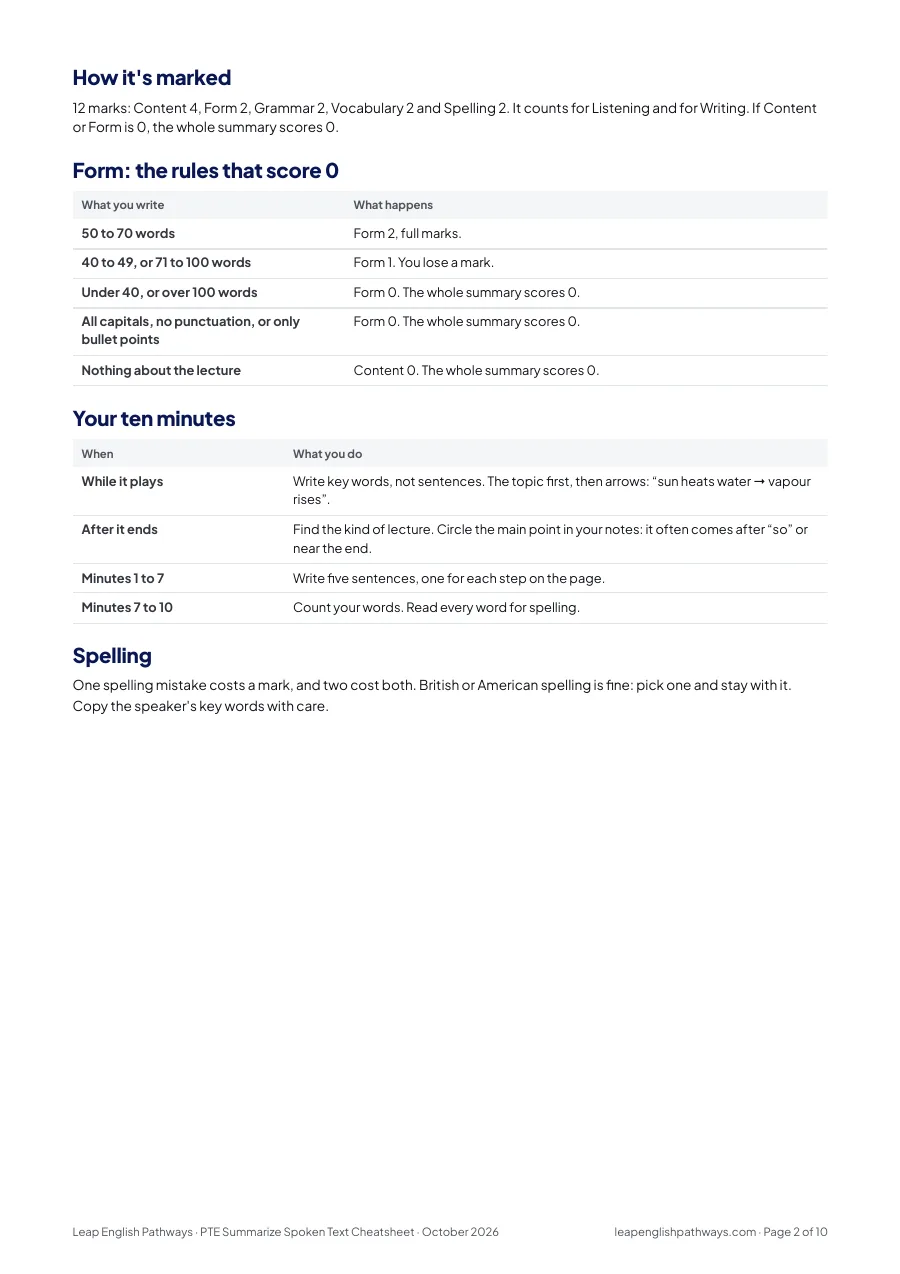
Write 50 to 70 words. Under 40 or over 100 scores 0 for the whole task.
Learn the shape, not the sentences. Keep the last 3 minutes to count words and check spelling.
An example answer
The how something works template, used on a real question. The PDF has an example answer for all 7 templates.
1The speaker explains how rain forms in the water cycle. 2First, the sun heats water, which evaporates and rises as vapour. 3As the vapour cools in the sky, it condenses into droplets and forms clouds. 4Then the droplets join until they are heavy enough to fall as rain. 5Finally, the cycle repeats, giving plants, animals and people the water they need.
자주 묻는 질문
Are templates allowed in PTE Summarize Spoken Text?
How many words in Summarize Spoken Text?
How is Summarize Spoken Text marked?
How should I use the 10 minutes?
Is the PDF free?
Summarize Spoken Text template 받기