
PTE Re-tell Lecture template
A sentence plan for each of the 8 kinds of lecture, with how to take notes while the speaker talks.

Por Thanh Tran, cofundación y docencia de PTE
Actualizado en
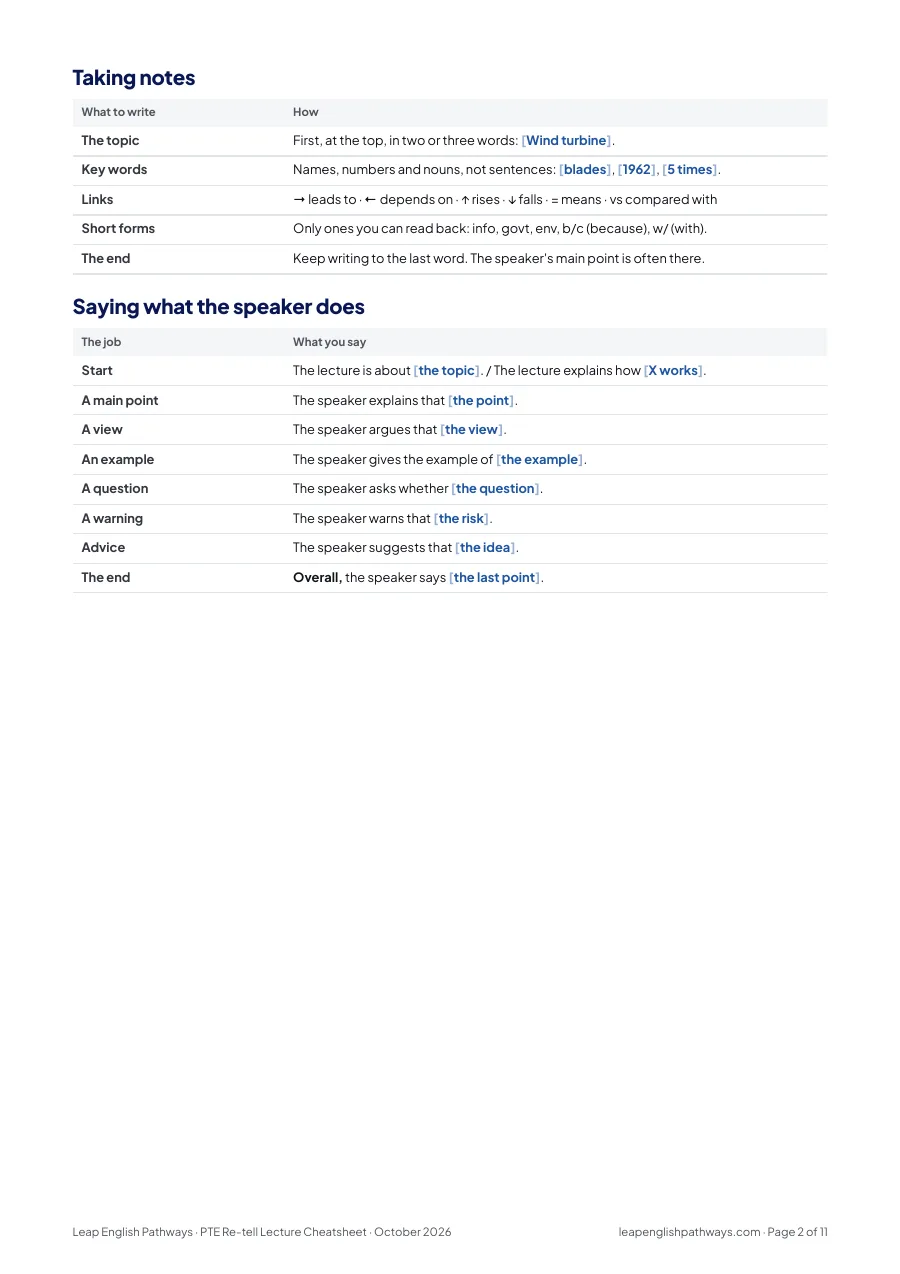
Which lecture is it?
Pick the kind of lecture you hear. Its template opens.
Blue: take it from your notes.Bold: a linking phrase.
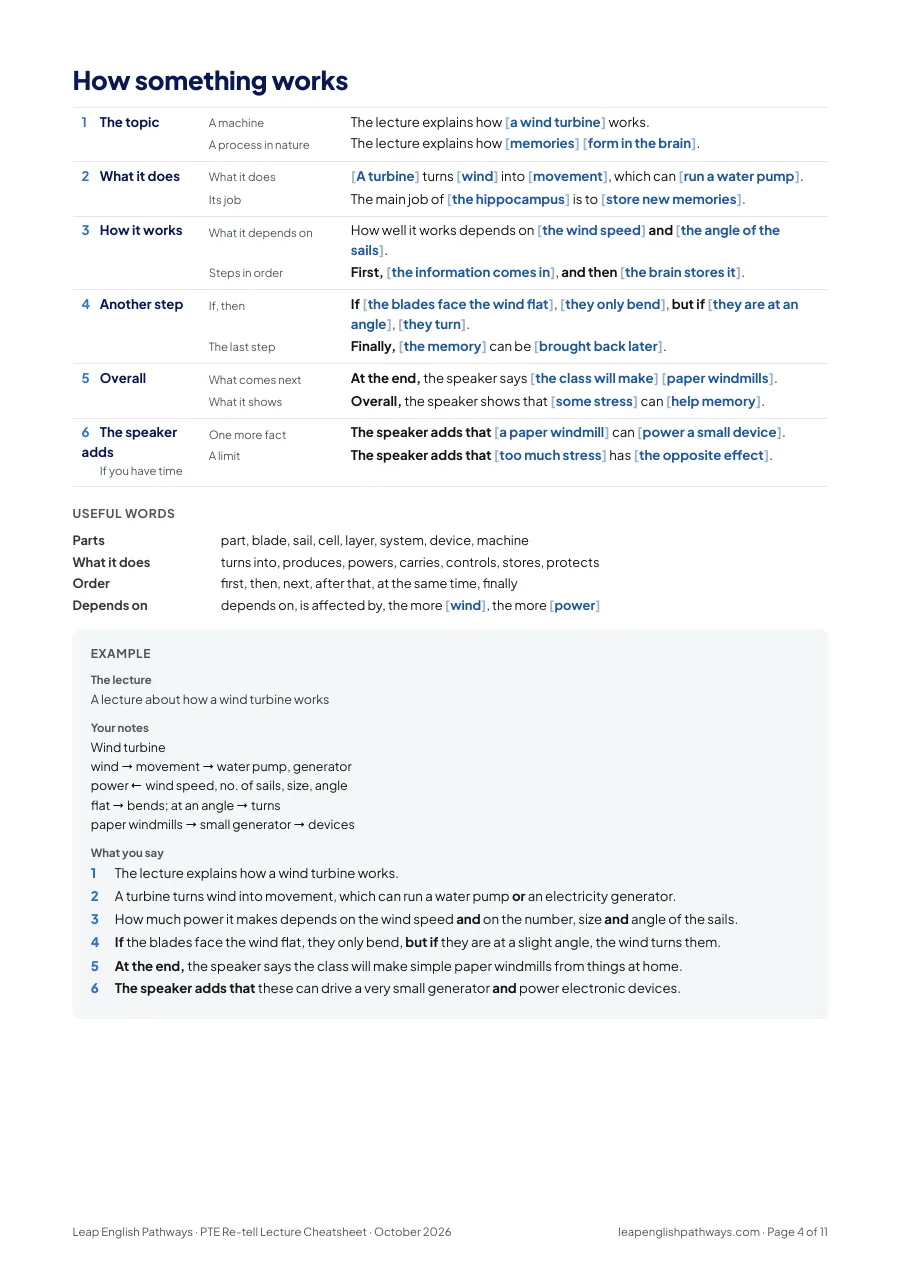
- The topic
- A machineThe lecture explains how a wind turbine works.
- A process in natureThe lecture explains how memories form in the brain.
- What it does
- What it doesA turbine turns wind into movement, which can run a water pump.
- Its jobThe main job of the hippocampus is to store new memories.
- How it works
- What it depends onHow well it works depends on the wind speed and the angle of the sails.
- Steps in orderFirst, the information comes in, and then the brain stores it.
- Another step
- If, thenIf the blades face the wind flat, they only bend, but if they are at an angle, they turn.
- The last stepFinally, the memory can be brought back later.
- Overall
- What comes nextAt the end, the speaker says the class will make paper windmills.
- What it showsOverall, the speaker shows that some stress can help memory.
- The speaker addsIf you have time
- One more factThe speaker adds that a paper windmill can power a small device.
- A limitThe speaker adds that too much stress has the opposite effect.
- The topic
- A questionThe lecture asks what forms clouds, and why they stay in the sky.
- A topicThe lecture is about why lack of sleep harms us.
- The main cause
- One causeThe speaker explains that every cloud drop needs a particle to form on.
- The main reasonThe main reason is a build-up of waste in the brain.
- Another cause
- A second causeOver the ocean, sea salt does this, but inland, pollution does.
- Another reasonAnother reason is the stress hormone, because it X.
- The effect
- The effectClouds reflect light, so they keep the planet cooler.
- A chainMore pollution leads to less rain, which leads to drought.
- Overall
- A warningOverall, the speaker warns that pollution is reducing rain.
- What it showsOverall, the speaker shows that sleep is needed to clean the brain.
- The speaker addsIf you have time
- What comes nextThe speaker adds that researchers are trying to find which sources matter most.
- Why it mattersThe speaker adds that clouds play a big part in climate change.
- The topic
- A habitThe lecture is about parents who speak two languages with their children.
- A problemThe lecture is about the problem of childhood obesity.
- What people think
- A beliefMany parents think it helps children learn, but the speaker sees a problem.
- How bigTwenty percent of children in the USA now have this problem.
- The problem
- The problemThe speaker says children get confused when X happens.
- The effectAs a result, heart disease is now common in young children.
- The fix
- One fixThe speaker suggests that each parent sticks to one language.
- Two fixesOne fix is less noise at the source, and another is better rules.
- Overall
- It worksThat way, the children are not confused any more.
- A call to actOverall, the speaker says we must deal with this now.
- What it meansIf you have time
- Two sidesSo two languages can work, as long as each parent keeps to one.
- Why it mattersThis matters because the problem can start to seem normal.
- The topic
- Two thingsThe lecture compares Earth and Mars, to see whether people could live there.
- Several placesThe lecture compares spending on education in the UK and the rest of Europe.
- How they are alike
- AlikeBoth planets have polar caps and an atmosphere.
- One leadsDenmark and Finland spend much more than the others.
- A difference
- A differenceBut on Earth, water is in oceans, while on Mars it is ice.
- NumbersThe UK spends only 1 percent, against an average of 4.6 percent.
- The big picture
- Mostly differentDespite these similarities, the two are still very different.
- Another differenceIn contrast, Spain spends about the same as the UK.
- Overall
- What they do about itTo prepare, scientists ran tests in Antarctica.
- One is behindOverall, the UK is among the bottom five for spending.
- The speaker addsIf you have time
- Why it mattersThe speaker adds that these tests help scientists get ready for Mars.
- What it meansSo the UK spends less than most of Europe.
- The topic
- A periodThe lecture is about the Green Revolution, which began in 1943.
- A personThe lecture is about Joseph Lister and his work on germs.
- How it started
- The startIt started when Mexico could not feed its people.
- Early lifeHe began his work in year, when X.
- What happened next
- NextBy 1962, a new rice called IR8 was feeding people around the world.
- A turning pointThen in year, X changed everything.
- A later step
- NumbersIR8 gave five times the harvest of older rice.
- LaterLater, in 1980, IR36 grew fast enough for two harvests a year.
- Overall
- The resultOverall, crop yields rose sharply from 1960 to 2000.
- What it changedOverall, his work changed how doctors treat wounds.
- The speaker addsIf you have time
- How it was doneThe speaker adds that IR8 was made by crossing older types of rice.
- Still todayThe speaker adds that this office still exists today.
- The topic
- A questionThe lecture asks whether people can get super strength in an emergency.
- A beliefThe lecture looks at the belief that astronomers spend every night at a telescope.
- The claim
- The claimMany stories say that people can lift a car to save someone.
- The real pictureIn fact, most astronomers spend their time analysing data.
- The evidence
- An exampleFor example, in 1995, a police officer lifted a car off a baby.
- The evidenceThere are many stories, but most of them are anecdotes.
- The doubt
- A doubtHowever, leverage or water probably made the job easier.
- Can't repeat itWhen people tried again, they could not do it.
- Overall
- Not provenOverall, the evidence is only stories, and it can't be repeated.
- Not trueOverall, the speaker shows that the belief is wrong.
- The speaker addsIf you have time
- Still possibleStill, the speaker says some people may gain great strength for a short time.
- The speaker addsThe speaker adds that the aim is not to prove each story wrong.
- The topic
- A part of scienceThe lecture explains the role of genes in biology.
- A termThe lecture explains thermodynamics, and where it came from.
- What it means
- Its jobGenes hold the information cells need to make proteins.
- A definitionThermodynamics is the science of how heat moves.
- How it works
- How it worksThe process is complex, with several stages where X happens.
- Where it came fromIt began in the 1800s, at the time of the Industrial Revolution.
- Why it matters
- Why it mattersProteins matter because living things need them to grow and repair.
- An exampleFor example, Arrhenius worked out the effect of CO2 in the late 1800s.
- Overall
- The linkOverall, genes pass instructions to proteins, and this is the basis of life.
- A warningOverall, his numbers showed that humans would be in trouble.
- The speaker addsIf you have time
- The pictureThe speaker adds that DNA stores this information and looks like a chain.
- The speaker addsThe speaker adds that his calculation was right.
- The topic
- A studyThe lecture describes a study of self-control in young children.
- A surveyThe lecture describes a survey of over 100 company leaders about mergers.
- What they did
- What they didResearchers offered children one marshmallow now or two later.
- Who took partThe researchers tested shy and bold fish in groups of three.
- What they found
- What they foundThey found that children who waited did better later in life.
- NumbersMost of them said X needed the most effort.
- Another finding
- ExamplesFor example, they had better relationships and better test scores.
- Another findingThey also found that bold fish led more trips anyway.
- Overall
- What it meansOverall, the study shows that being able to wait is an important skill.
- A matchOverall, fish prefer to follow fish like themselves.
- The speaker addsIf you have time
- Good newsThe speaker adds that this skill can be taught at any age.
- Where it's fromThe speaker adds that the findings are in the journal Biology Letters.
Ahora pruébalo con una pregunta real
Responde una pregunta de Re-tell Lecture en nuestra app de práctica. Nuestro sistema de corrección la califica en segundos, para que sepas qué corregir después.
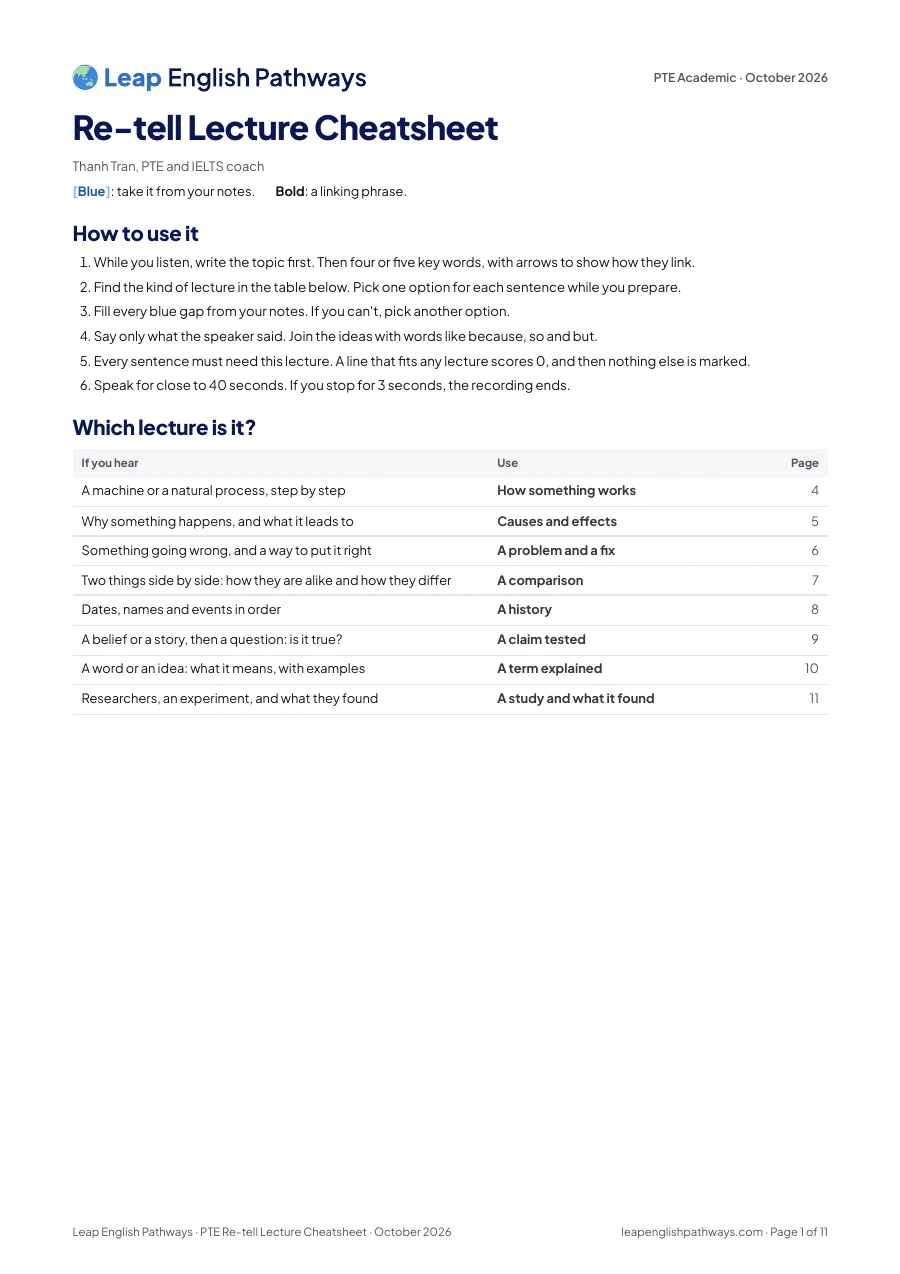
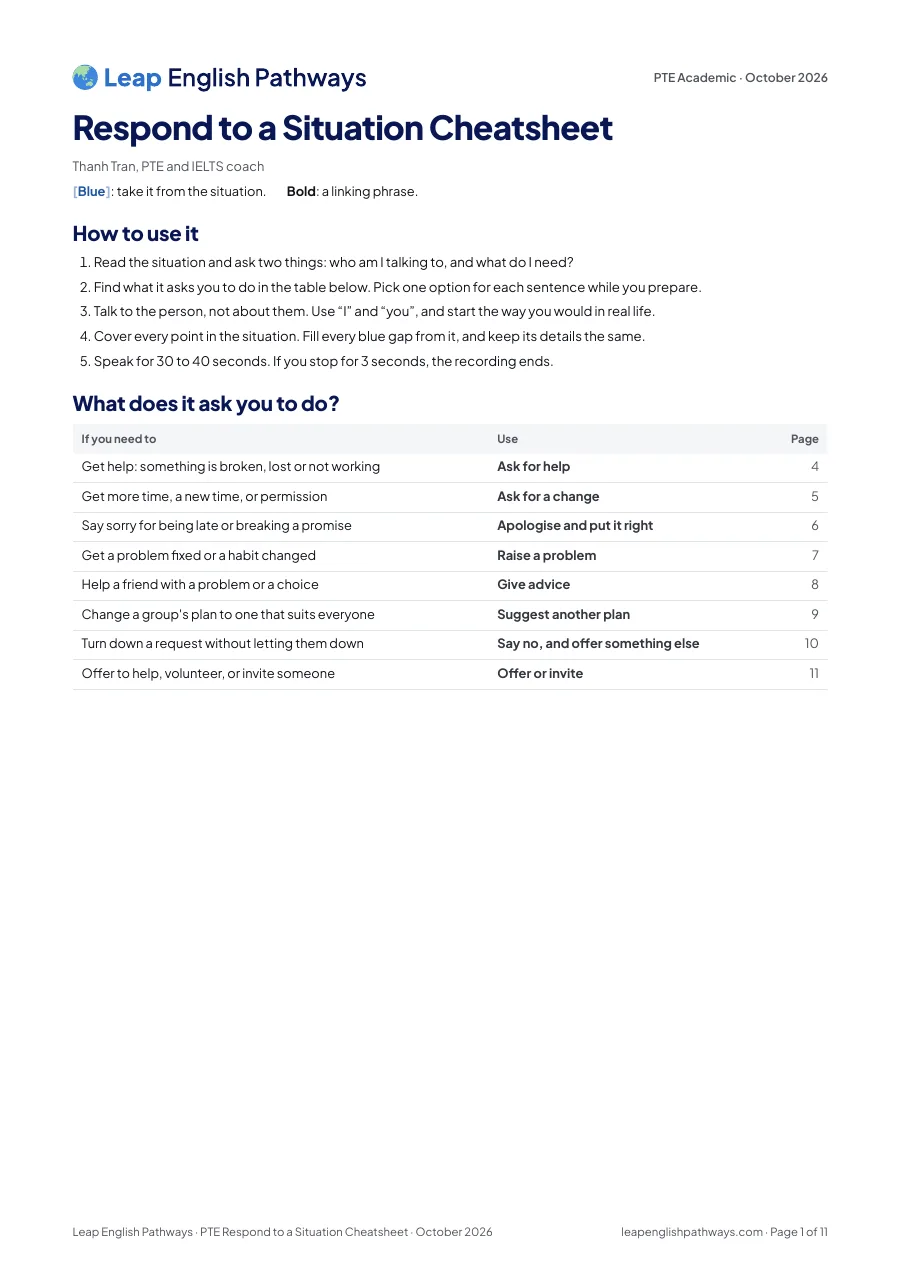
How to use it
While you listen, write the topic first. Then four or five key words, with arrows to show how they link.
Find the kind of lecture in the table below. Pick one option for each sentence while you prepare.
Fill every blue gap from your notes. If you can't, pick another option.
Say only what the speaker said. Join the ideas with words like because, so and but.
Every sentence must need this lecture. A line that fits any lecture scores 0, and then nothing else is marked.
Speak for close to 40 seconds. If you stop for 3 seconds, the recording ends.
An example answer
The how something works template, used on a real question. The PDF has an example answer for all 8 templates.
- The lecture explains how a wind turbine works.
- A turbine turns wind into movement, which can run a water pump or an electricity generator.
- How much power it makes depends on the wind speed and on the number, size and angle of the sails.
- If the blades face the wind flat, they only bend, but if they are at a slight angle, the wind turns them.
- At the end, the speaker says the class will make simple paper windmills from things at home.
- The speaker adds that these can drive a very small generator and power electronic devices.
Preguntas frecuentes
Are templates allowed in PTE Re-tell Lecture?
What should I write while I listen?
What if I missed part of the lecture?
How long should I speak in Re-tell Lecture?
Is the PDF free?
Descarga Re-tell Lecture template