
How to improve your IELTS Listening band
Why natural speech is hard to follow, the tricks the recording plays, and a routine for learning from each mistake.
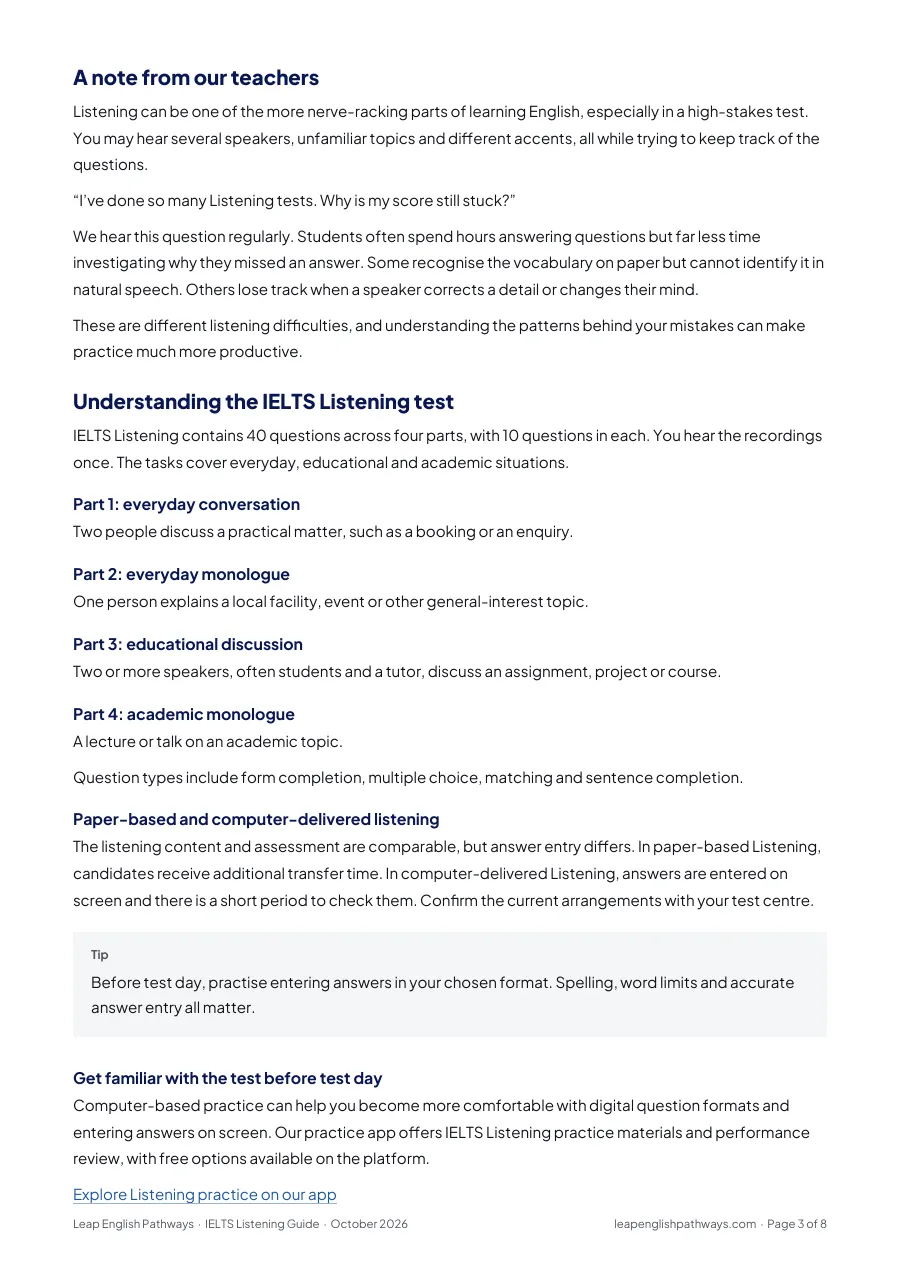
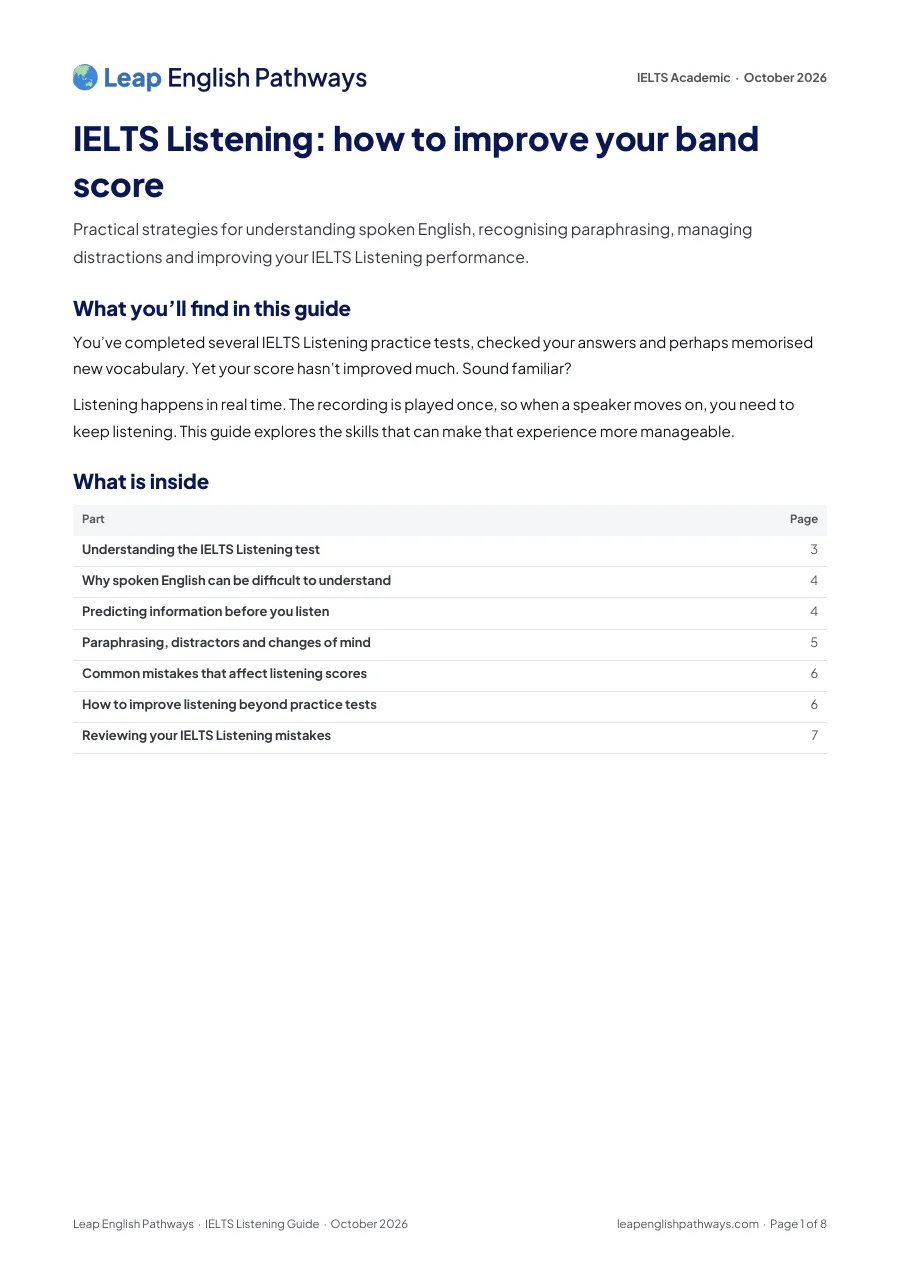
What's in the guide
8 pages in 7 parts. Find the part you need, then turn to its page.
- Page 3
The four parts
What you hear in each part, and how you enter answers on paper and on computer.
- Page 4
Why speech is hard to follow
Words that run together, stress and different accents, with a tutor's sentence as an example.
- Page 4
Predicting the answer
Use the time before each part to guess what kind of answer you need.
- Page 5
Paraphrasing and distractors
The same idea in other words, an answer that changes, and the words that tell you.
- Page 6
Common mistakes
Spelling, plurals, numbers, word limits and losing focus after a missed answer.
- Page 6
Practice beyond tests
A five-step listening routine, short dictations and listening every day.
- Page 7
Reviewing your mistakes
Find out why you missed each answer, and what to practise next.
Tips from the guide
- Before test day, practise entering answers the way you will on the day. Spelling and word limits count.
- Play a hard part again with its transcript. Notice where words join and which words are stressed.
- After a test, ask why you missed each answer: a word, a correction, a number, your focus or your spelling.
Three ways the recording tests you
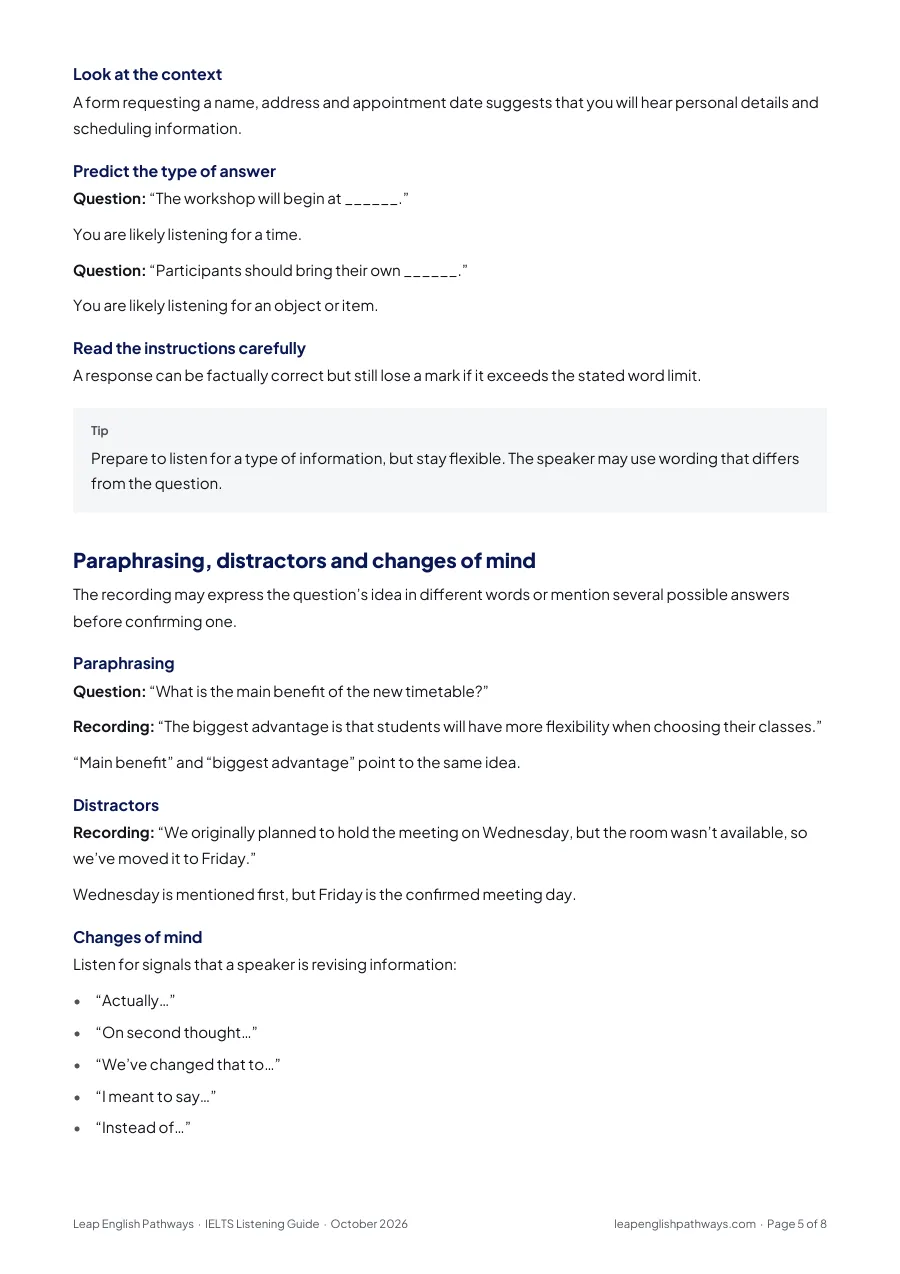
The recording often says the question's idea in other words, or gives one answer before it changes it. Listen to the whole idea before you write.
From page 5 of the guide.
Paraphrasing
- Question
- “What is the main benefit of the new timetable?”
- Recording
- “The biggest advantage is that students will have more flexibility when choosing their classes.”
“Main benefit” and “biggest advantage” point to the same idea.
Distractors
- Recording
- “We originally planned to hold the meeting on Wednesday, but the room wasn’t available, so we’ve moved it to Friday.”
You hear Wednesday first, but the meeting is on Friday.
Changes of mind
Listen for the words a speaker uses to change a detail: “Actually…”, “On second thought…”, “We’ve changed that to…”, “I meant to say…” and “Instead of…”.
Practise IELTS ListeningIELTS Listening testIELTS Academic exam format
よくある質問
How many parts are in IELTS Listening?
Why do I lose marks when I understood the recording?
Will more practice tests raise my score?
Is the PDF free?
IELTS Listening guide を受け取る